
Armenia–Germany: Greener. Smarter. Stronger
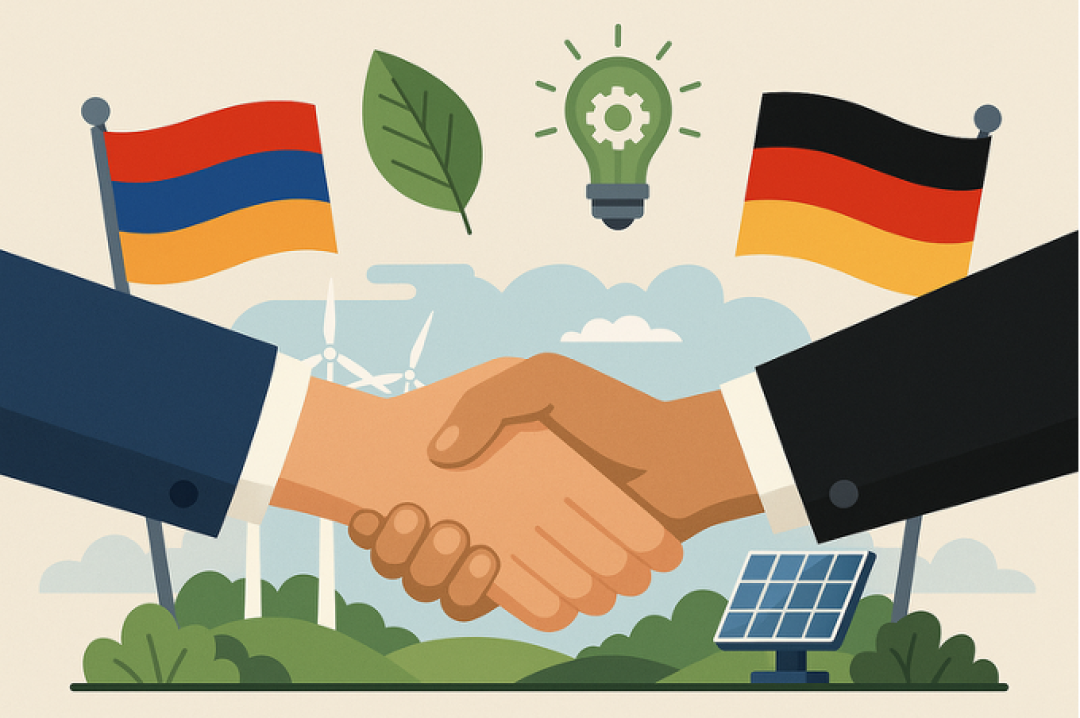
When Armenians think of Germany, they often associate it with precision and reliability. In recent years, however, this image has expanded — Germany has become a key driver of Armenia’s institutional modernization, renewable-energy transition, and skills development.
From energy infrastructure to vocational training and SME support, the Armenia–Germany partnership has evolved into a structured framework emphasizing sustainability and practical cooperation.
As noted by Edgar Vardanyan, a political scientist and independent researcher, in an interview for this article:
“Germany is not only a bilateral partner — it is Armenia’s bridge to Europe. Its engagement goes beyond traditional aid, representing a model of partnership built on institutional trust, long-term planning, and mutual accountability — elements that increasingly define Armenia’s path toward European integration.”
This multidimensional cooperation rests on tangible results and a clear long-term framework.
Partnership Framework and Priorities
In 2024, Armenia–Germany trade reached €554 million, placing Germany among Armenia’s leading EU trading partners (German Federal Foreign Office, 2024). Beyond trade, cooperation has deepened through a range of development, educational, and institutional programmes coordinated by German agencies such as GIZ and KfW Development Bank, together with German political foundations active in Armenia.
The Armenian Ministry of Foreign Affairs identifies Germany as a priority partner within the European integration and public diplomacy agenda, particularly in the areas of sustainable energy and capacity-building.
Energy Transition and Environmental Cooperation
As Armenia plans to increase renewables to 15% by 2030, German projects provide the technical and financial backbone for that transition.
Armenia remains dependent on energy imports for over 80 percent of its supply. According to the International Energy Agency (IEA), the country’s 2021 energy mix consisted of approximately 62% natural gas, 16% oil, 14% nuclear, 5% hydropower, and 1% solar and wind. Despite the modest share of renewables, this is a rapidly expanding sector in which German assistance plays a key role.
Through KfW Development Bank and the German-Armenian Fund, Germany has provided more than €130 million in concessional financing for renewable-energy and energy-efficiency projects. A central initiative is “Advancing Armenia’s Climate-Resilient and Resource-Efficient Development”, implemented by GIZ, which supports municipalities and national partners in expanding renewable energy, improving energy efficiency, and strengthening local climate adaptation capacities. These efforts align with Armenia’s national decarbonization goals and its commitments under the Paris Agreement.
Vocational Education and Human-Capital Development
Germany’s experience with dual vocational education has informed ongoing reform of Armenia’s VET system. The Private Sector Development and VET in the South Caucasus programme (GIZ, BMZ, EU co-financed) — with a total budget of around €46 million — supports curriculum modernization, instructor training, and closer cooperation between educational institutions and employers.
In 2025, a €15.6 million technical-cooperation package was signed, allocating funds to vocational education, SME support, and sustainable-energy initiatives. These projects aim to link skills development with labour-market demand, contributing to a more adaptive economy. These projects aim to link skills development with labour-market demand, creating a more adaptive economy and preparing a generation of workers for green and digital industries.
SMEs and Private-Sector Modernization
Support to small and medium-sized enterprises remains a central element of bilateral cooperation. Through the German-Armenian Fund, businesses receive affordable credit for modernization, renewable-energy installations, and resource-efficient technologies.
According to KfW Development Bank, cumulative financing includes approximately €111 million for SME promotion and €72 million for energy-efficient housing (KfW, 2024). These mechanisms foster entrepreneurship, promote energy efficiency, and gradually diversify Armenia’s economic base.
Academic and Civic Cooperation
German foundations — including Friedrich Ebert Stiftung (FES), Konrad Adenauer Stiftung (KAS), Friedrich Naumann Stiftung (FNS), and the Heinrich Böll Stiftung (HBS) — maintain programmes in political education, policy research, and youth engagement. Such initiatives, along with university partnerships and research exchanges, contribute to stronger professional networks and policy dialogue between the two countries.
Nonetheless, some practical challenges remain. Visa delays and limited appointment capacities continue to hinder academic and cultural exchange, suggesting an area where administrative improvements could enhance cooperation. Overcoming such administrative hurdles would allow the social and intellectual dimension of Armenia–Germany relations to match the success of its economic and technical cooperation.
Outlook
The Armenia–Germany partnership demonstrates a gradual shift from traditional development assistance toward policy-based cooperation and institutional alignment.
Its strength lies in projects that combine technical expertise with local implementation — in areas ranging from renewable energy and vocational training to SME competitiveness. Looking ahead, aligning these bilateral initiatives with broader EU–Armenia cooperation frameworks could further enhance their sustainability and policy coherence.
From energy transition to skills development, Armenia and Germany are building a partnership defined by sustainability, innovation, and shared European values — one that grows greener, smarter, and stronger each year.
Contributed by Siranush Grigoryan, a Lecturer at Armenian National Polytechnic University.