
Armenia Hosts Historic EPC Summit: All Important Details
Source: primeminister.am
On May 4–5, Armenia hosted major European and regional leaders at the European Political Community Summit alongside multiple high-level bilateral meetings, EU and NATO engagement, Armenia–EU strategic deepening, Armenian–French and regional cooperation advances, and a video address by Azerbaijani President Ilham Aliyev declaring progress toward Armenia–Azerbaijan peace and expanding connectivity.
Armenia And Belgium Inaugurate New Embassy In Yerevan
On May 4, Nikol Pashinyan, the Prime Minister of Armenia, and Bart De Wever, the Prime Minister of the Kingdom of Belgium, attended the opening ceremony of the Belgian Embassy in Yerevan, where both leaders delivered remarks. Pashinyan stated that the inauguration reflects the steady development of bilateral relations, grounded in long-standing historical ties and evolving into a modern partnership focused on strengthening democracy, the rule of law, and institutions in Armenia. He emphasized that democracy will ensure prosperity and success for the country and its citizens, while expressing gratitude for Belgium’s continued support, particularly in advancing Armenia’s cooperation with the European Union. "We perceive this as a very bold support for Armenian statehood, sovereignty, independence, territorial integrity, democracy," Pashinyan stated. He added that the opening of the embassy would further stimulate the deepening of relations. De Wever, for his part, highlighted the role of the Armenian community in Belgium as a "living bridge" between the two nations and described the embassy’s opening as "a historic moment." He stressed that it symbolizes not only enduring ties but also a commitment to expanding cooperation in business, innovation, technology, infrastructure, and scientific exchange, adding that "Belgium stands firmly by Armenia’s side."
Official Ceremony and Meetings
The official welcoming ceremony for the leaders participating in the 8th Summit of the European Political Community was held at the Karen Demirchyan Sports and Concert Complex in Yerevan, followed by the opening session and a joint family photo of attending heads of state, government leaders, and representatives of international organizations.
On the sidelines of the summit, Pashinyan held a series of bilateral meetings. During his meeting with Andrej Plenković, the Prime Minister of Croatia, Pashinyan emphasized the high level of political dialogue between the two countries and noted that relations were being elevated to the level of strategic dialogue. He underlined the significant potential for further cooperation, expressing confidence in its expansion. Plenković welcomed the opportunity to participate in the summit and stated that the meeting would provide new momentum to bilateral, multi-sectoral ties. The sides discussed regional issues and prospects for cooperation, after which they signed a joint declaration on strategic dialogue.
During talks with Mark Rutte, the Secretary General of NATO, Pashinyan emphasized the importance of deepening Armenia-NATO cooperation, particularly in the context of democratic reforms and defense sector development. The parties discussed regional security issues and reaffirmed their readiness to continue constructive dialogue based on shared values and mutual trust.
In a meeting with Keir Starmer, the Prime Minister of the United Kingdom of Great Britain and Northern Ireland, Pashinyan described the visit as historic, noting it was the first by a UK Prime Minister to Armenia. He expressed confidence that it would give new impetus to bilateral relations. Starmer emphasized the importance of expanding cooperation across multiple sectors and praised the organization of the summit. The sides exchanged views on bilateral and regional matters and adopted a joint declaration on strategic partnership.
Pashinyan also met with Pedro Sánchez, the Prime Minister of Spain, to discuss prospects for enhancing political dialogue and expanding economic cooperation. He presented Armenia’s ongoing reform agenda, emphasizing efforts to strengthen democracy, the rule of law, and economic development. Both sides highlighted opportunities in sectors such as energy, tourism, and the broader Armenia–European Union partnership, while also underlining the importance of maintaining regional stability and dialogue on international platforms.
During the meeting with Volodymyr Zelenskyy, the President of Ukraine, the parties discussed the development of bilateral cooperation and emphasized the need to deepen engagement in areas of mutual interest. They also exchanged views on regional and global developments, stressing the importance of achieving lasting peace.
In talks with Cevdet Yilmaz, the Vice President of Türkiye, Pashinyan emphasized the significance of the visit for bilateral relations. Yilmaz expressed appreciation for the hospitality and invitation to the summit. The sides discussed the normalization process between Armenia and Türkiye and the implementation of previously reached agreements. Following the meeting, a protocol was signed on joint restoration works for the historic Ani (Silk Road) Bridge on the Armenia–Türkiye border, with Ruben Rubinyan and Serdar Kılıç signing on behalf of their respective countries.
Finally, during the meeting with Nikos Christodoulides, the President of Cyprus, the parties discussed prospects for deepening Armenia–Cyprus relations, focusing on enhancing political dialogue and economic cooperation. They also addressed regional developments and reaffirmed their willingness to expand collaboration across areas of mutual interest. The discussion included the Armenian Government’s "Crossroads of Peace" initiative aimed at unblocking regional transport routes, as well as the TRIPP project.
Aliyev's Speech
Ilham Aliyev, the President of Azerbaijan, addressed the participants via video link. Aliyev expressed gratitude for the invitation and recalled discussions with António Costa, the President of the European Council, regarding his remote participation. He noted that he had supported the proposal to hold the 2026 summit in Armenia and, in turn, invited EPC members to Azerbaijan for the 2028 summit, adding that Armenia had also backed this candidacy. According to Aliyev, this mutual support demonstrates that "peace between Azerbaijan and Armenia is a reality," emphasizing that both sides have been "learning to live in peace" over the past months.
He referred to the Joint Declaration signed in Washington at the White House last August by the leaders of Armenia and Azerbaijan, with US President Donald Trump acting as a witness, and noted that the foreign ministers had initialed the peace agreement. Aliyev stated that, following these developments, Azerbaijan unilaterally lifted transit restrictions imposed in the early 1990s, resulting in the delivery of 28,000 tons of cargo to Armenia. He added that Azerbaijan had also begun exporting gasoline and diesel to Armenia, marking the start of trade relations, with 12,000 tons of oil products supplied so far.
Aliyev highlighted connectivity as another outcome of the peace process, pointing to the "Trump Route for International Peace and Prosperity," which is expected to link Azerbaijan with its exclave Nakhchivan and form part of the Middle Corridor. He expressed appreciation to the European Commission for its stance on the Armenia–Azerbaijan normalization process, while criticizing other European institutions, including the European Parliament and the Parliamentary Assembly of the Council of Europe, for what he described as "double standards." He noted that Azerbaijan’s delegation to PACE faced restrictions in January 2024, months after Baku restored control over the separatist Garabagh region, and argued that such actions undermine trust.
Aliyev further criticized the European Parliament for adopting multiple resolutions against Azerbaijan, stating that 14 such documents had been passed since 2021, including one shortly before the summit. In response, he noted that Azerbaijan’s parliament had decided on May 1 to suspend cooperation with the European Parliament, halt participation in the EU–Azerbaijan Parliamentary Cooperation Committee, and initiate procedures to withdraw from the Euronest Parliamentary Assembly. He emphasized that his remarks aimed to inform participants and prevent "misinformation or manipulation."
Concluding his address, Aliyev congratulated Nikol Pashinyan, the Prime Minister of Armenia, on hosting the summit and reaffirmed Azerbaijan’s commitment to the peace agenda.
In his remarks, Pashinyan stated that peace between Armenia and Azerbaijan has been achieved, noting that there have been no casualties for two years, which he described as unprecedented since independence. He emphasized that efforts are underway to institutionalize and strengthen peace. Pashinyan also pointed out that this marked the first time the President of Azerbaijan participated in an event hosted in Armenia, albeit remotely, and expressed hope to attend the 2028 summit in Azerbaijan. He added that both countries had mutually supported each other’s candidacies to host EPC summits.
Concluding Statements
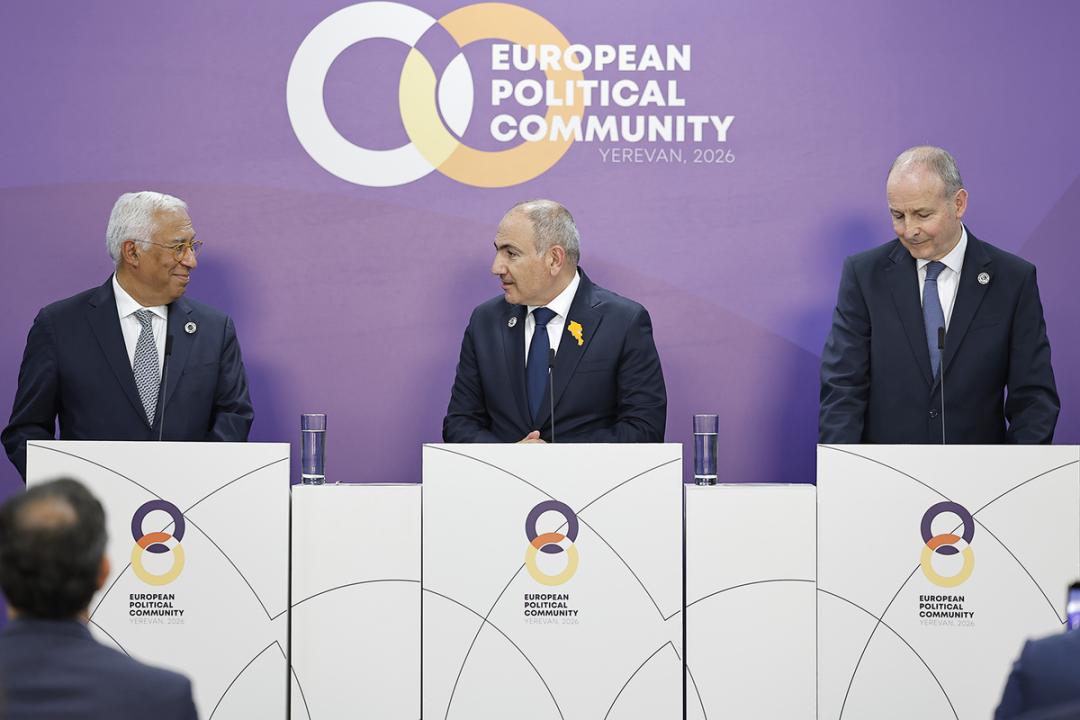
On May 4, Nikol Pashinyan, the Prime Minister of Armenia, António Costa, the President of the European Council, and Micheál Martin, the Prime Minister of Ireland, delivered concluding statements to the media following the 8th Summit of the European Political Community in Yerevan.
Pashinyan stated that the summit had "successfully concluded," bringing together leaders from across different regions. He expressed gratitude to the European Union for close cooperation in organizing the event, particularly highlighting the role of partners in expanding the forum’s reach. He also noted the remote participation of the President of Azerbaijan and the attendance of the Vice President of Türkiye. According to Pashinyan, the discussions underscored the need for "sincere dialogue and practical solutions" in addressing global challenges, with a focus on security, stability, connectivity, regional cooperation, economic resilience, energy, and the green transition.
He emphasized that connectivity remains central to economic stability and long-term sustainability, adding that open and interconnected regions are essential for fostering intercontinental links. In this context, Pashinyan highlighted the importance of advancing peace and normalization in the South Caucasus, stating that "lasting peace, normalization of relations and opening of borders" would benefit not only the region but also the broader European space. He further noted that the participants discussed ways for democracies to counter hybrid threats.
Pashinyan stressed that Armenia continues to promote initiatives aimed at strengthening regional connectivity and described the European Political Community as both a platform for dialogue and a mechanism for building trust and shaping a forward-looking agenda. He expressed confidence that the outcomes of the Yerevan discussions would contribute to deeper cooperation and mutual understanding. Addressing Micheál Martin, he noted that the next summit would be hosted in Ireland, and extended appreciation to the media for their coverage of the event. He also thanked Costa for his role in the organization of the summit and for supporting Armenia’s candidacy to host it.
Armenia And France Cement Strategic Partnership With State Dinner And Mutual Highest Honors
On May 4, Vahagn Khachaturyan, the President of Armenia, and Nikol Pashinyan, the Prime Minister of Armenia, hosted a state dinner at the Presidential Palace in honor of Emmanuel Macron, the President of France. Prior to the dinner, a ceremony for the presentation of state awards was held. By decree of Khachaturyan, Macron was awarded the Order of Glory for his significant personal contribution to strengthening Armenian-French relations and expanding bilateral cooperation. In turn, by Macron’s decision, Khachaturyan and Pashinyan were awarded the Grand Cross of the Legion of Honor, the highest degree of the order established by Napoleon Bonaparte in 1802.
During the dinner, the leaders exchanged toasts and addressed the current state and future prospects of Armenia–France relations.
In his remarks, Pashinyan described Macron’s visit as a "very important and great event," emphasizing both the traditional friendship between the two countries and Macron’s personal role in elevating bilateral ties to their current level. He noted that this progress would be formalized through the adoption of a strategic partnership document. At the same time, Pashinyan highlighted Armenia’s broader transformation, stating that the country has moved beyond a "survival agenda" and entered a phase focused on development, guided by what he described as the ideology of the "Real Armenia."
Pashinyan stressed that Macron played a pivotal role in shaping Armenia’s current regional strategy, particularly referring to the quadrilateral meeting in Prague on October 6, 2022. He emphasized that Macron demonstrated "conviction, devotion, principledness and determination," adding that the outcomes of that meeting became a cornerstone for Armenia’s present trajectory toward peace and stability. According to Pashinyan, in difficult moments when Armenia lacked support, "we felt and touched President Macron’s hand," underlining his consistent backing for Armenia’s statehood, sovereignty, and security. He further noted that Macron’s responses to Armenia’s concerns were always timely and translated into "concrete, tangible, verifiable" actions.
Pashinyan concluded by proposing a toast to Macron, describing him as a "great friend" and "brother of the Republic of Armenia," and emphasizing that the award granted to him reflects Armenia’s appreciation for his contributions.
In his response, Macron stated that he was deeply moved by Pashinyan’s remarks and recalled the events of 2022, describing the situation at the time as highly unstable. He emphasized that France’s support for Armenia stemmed from a sense of justice, noting that "France has done its duty in such moments," even when others questioned its position. Macron stressed that France has consistently supported what it considers "just struggles," including Armenia’s efforts to safeguard its sovereignty and territorial integrity.
Macron highlighted the historical depth of Armenian-French relations, pointing to shared experiences and values, as well as the role of the Armenian community in France. He referred to figures such as Missak Manouchian and Mélinée, emphasizing their symbolic importance in the shared history of the two nations. According to Macron, the bond between Armenia and France is rooted in mutual recognition and solidarity in moments of hardship.
He also underlined France’s support for Armenia’s strategic choices, including its pursuit of independence, peace, stability, and closer ties with Europe. Macron noted that the strategic partnership agreement to be signed would further strengthen cooperation in defense, economy, education, culture, and other sectors. He emphasized that Armenia’s vision of a peaceful and prosperous future aligned with European values is fully supported by France.
Macron concluded by praising Armenia’s leadership for pursuing peace despite regional challenges, stressing that such a path requires courage. He reaffirmed France’s commitment to standing alongside Armenia and proposed a toast to the enduring friendship between the two nations.
Armenia And European Union Hold First-Ever Bilateral Summit
On May 5, Nikol Pashinyan, the Prime Minister of Armenia, hosted António Costa, the President of the European Council, and Ursula von der Leyen, the President of the European Commission, at the presidential residence in Yerevan within the framework of the inaugural Armenia–EU summit. The visit began with an official welcoming ceremony featuring the anthems of Armenia and the European Union, followed by a military march. A private meeting was then held, after which the discussions continued in an expanded format.
Welcoming the delegation, Pashinyan stated that the summit marked a historic step, noting that "for the first time in history, the Republic of Armenia and the European Union are holding a bilateral summit." He emphasized that relations are being elevated to a "qualitatively new level," adding that a substantial agenda has already been formed. According to him, prior discussions revealed common positions on key issues, creating favorable conditions to focus on implementation.
Pashinyan expressed appreciation for the EU’s continued support, particularly in democratic and institutional reforms. He stressed that democracy in Armenia is a deliberate strategic choice, stating that "democracy for us is not a random occurrence of circumstances, but a strategy." He underlined the need for further institutional, legislative, and expert support to advance reforms, including strengthening judicial independence and addressing hybrid threats. The Prime Minister also pointed to challenges such as disinformation and hate speech, expressing hope for deeper cooperation with the EU through the exchange of experience and access to relevant tools.
Costa, in his remarks, described both the European Political Community Summit held the previous day and the Armenia–EU summit as "historic moments," emphasizing that the latter sends a clear signal about the EU’s intention to deepen relations with Armenia. He noted that Armenia is entering "a new period of peace" and democratic consolidation, which creates favorable conditions for cooperation. Referring to the EU–Armenia Strategic Partnership Agenda adopted in December, Costa highlighted ongoing collaboration in areas including security and defense through the European Peace Facility.
He also underlined the role of the EU Partnership Mission in strengthening Armenia’s democratic resilience, describing it as a tangible expression of shared commitment to addressing challenges. Costa emphasized the importance of supporting the Armenian people’s right to determine their future, adding that the EU stands ready to advance along this path together. He further noted Armenia’s strategic role in connecting Europe with the South Caucasus, the Caspian region, and Central Asia, expressing hope that the summit would pave the way for a strengthened partnership and a shared future based on peace and prosperity.
Von der Leyen highlighted the deep historical and cultural ties between Armenia and Europe, stating that the relationship is also driven by future opportunities. She noted that Armenia and the EU are "closer than ever," pointing to progress toward visa liberalization and planned investments of 2.5 billion euros under the "Global Gateway" initiative. According to her, Armenia’s geographic position provides the shortest route linking Europe with Central Asia and the Caspian region, adding that recent developments driven by Armenia’s "courageous choice for the sake of peace" could transform the country into a regional hub. She reaffirmed the EU’s readiness to support this process and concluded by stating, "Long live our partnership."
Following the summit, Armenia and the European Union adopted a joint declaration and signed several documents. Among them was an agreement on the Armenia–EU Connectivity Partnership, signed by Vahan Kostanyan and Adrienn Király. The EU also issued six letters of intent to Armenian companies and foundations to encourage investment within this framework.
Additionally, a working arrangement on operational cooperation in border management was initialed between Armenia’s Ministry of Internal Affairs and the European Border and Coast Guard Agency, with Arpine Sargsyan and Hans Leijtens signing the document. During the event, Vassilis Maragos handed over the European Commission’s progress report on Armenia’s Visa Liberalization Action Plan to Sargsyan, outlining recommendations for achieving full visa-free travel upon meeting all requirements.
The sides also agreed to launch a call for expressions of interest for companies registered in the EU, EEA, and Armenia to invest in projects supporting connectivity and economic development.
EU–Georgia Tensions Surface In Yerevan As Kallas Warns Of EU Divergence
On May 4, Kaja Kallas, the EU High Representative for Foreign Affairs and Security Policy, spoke to journalists in Yerevan ahead of the European Political Community Summit, addressing regional dynamics and relations with Georgia. She emphasized the strategic importance of the South Caucasus, stating that "the Yerevan summit shows how important the Caucasus is," particularly in light of ongoing instability, including the war in Iran. Kallas highlighted the need for unity and resilience in responding to emerging threats.
Addressing connectivity, Kallas described the Middle Corridor as "very important," noting that shifting geopolitical conditions have intensified discussions on diversifying trade routes and reducing risks associated with disruptions. She emphasized that strengthening such corridors requires identifying reliable partners and enhancing cooperation.
Commenting on EU–Georgia relations, Kallas stated that the Georgian government is not taking sufficient steps toward European integration and is instead "moving in the wrong direction." She added that this creates limitations for the European Union, including in areas such as financial support. "We have certain issues with Georgia," Kallas stated, stressing that the gap between declared ambitions and actual policies remains a concern.
Responding to these remarks, Irakli Kobakhidze, the Prime Minister of Georgia, rejected the criticism, describing it as "regrettable and unfair." He argued that recent government actions must be understood in the context of alleged attempts to destabilize the country over the past four years, claiming that "there have been five different attempts to organize a revolution in Georgia," involving external actors such as NGOs, political parties, and media organizations. According to Kobakhidze, legislative measures were adopted to safeguard national interests against foreign interference.
Kobakhidze further stated that criticism from European actors is driven by political motives rather than objective assessment. "When there is a blatant political interest, arguments do not work," he noted, alleging that Georgia had faced pressure, including demands to join a war, followed by what he described as continued "blackmail" against the government and population. He added that some actors were attempting to use European institutions to advance these interests.
Speaking about his participation in the summit, Kobakhidze noted that he held discussions with numerous European leaders and took part in a roundtable focused on connectivity, particularly in the energy sector. He stated that these exchanges allowed Georgia to present its perspectives and engage on issues of national importance.
Kobakhidze also addressed what he described as disinformation originating from European institutions, calling it "a serious problem" and expressing hope that the situation would improve. He noted that while certain politicians attending the summit had previously made "unfair statements" regarding Georgia, no direct criticism was voiced during the event itself. According to him, the format of the summit provided an opportunity to engage broadly with international partners and communicate Georgia’s position on current developments.
Kobakhidze And Zelenskyy Reopen Dialogue On Sidelines
On May 4, Irakli Kobakhidze, the Prime Minister of Georgia, met with Volodymyr Zelenskyy, the President of Ukraine, on the sidelines of the 8th Summit of the European Political Community in Yerevan. According to the Georgian Government Administration, the meeting was held at the initiative of the Ukrainian side and focused on bilateral relations, with the foreign ministers of both countries also in attendance.
Commenting on the talks, Kobakhidze stated that the discussion was held in a closed format but described it as "a friendly and interesting conversation." He emphasized that Ukraine remains "a friendly country" for Georgia, highlighting the longstanding ties between the two nations and noting that the dialogue centered on bilateral relations. He added that maintaining this historical friendship is important, while refraining from disclosing further details due to the nature of the meeting.
Zelenskyy, in turn, confirmed the meeting and noted that "there are indeed unresolved issues between our states," stressing the importance of maintaining dialogue at all levels. He reiterated that Ukraine respects Georgia’s sovereignty and people, adding that cooperation between the two countries will continue. Speaking to media, Zelenskyy underlined that this was the first face-to-face conversation with Kobakhidze in a long time, stating that "this is right."
Within the same framework, Andrii Sybiha, the Minister of Foreign Affairs of Ukraine, held a meeting with Maka Botchorishvili, the Minister of Foreign Affairs of Georgia. Sybiha stated that the sides exchanged views on bilateral, regional, and international developments, including European integration and the role of the European Union in global affairs. He noted that particular attention was given to expanding trade and economic cooperation and added that the parties agreed to remain in contact.
News,
Politics,
Armenia |
EU, NATO, Nikol Pashinyan, France, Irakli Kobakhidze, Mark Rutte, Armenia-EU Relations, Emmanuel Macron, Volodymyr Zelenskyy, Kaja Kallas, António Costa, EPC, Keir Starmer, Pedro Sánchez