
Azerbaijan Advances Middle Corridor and TRIPP Projects with Partners
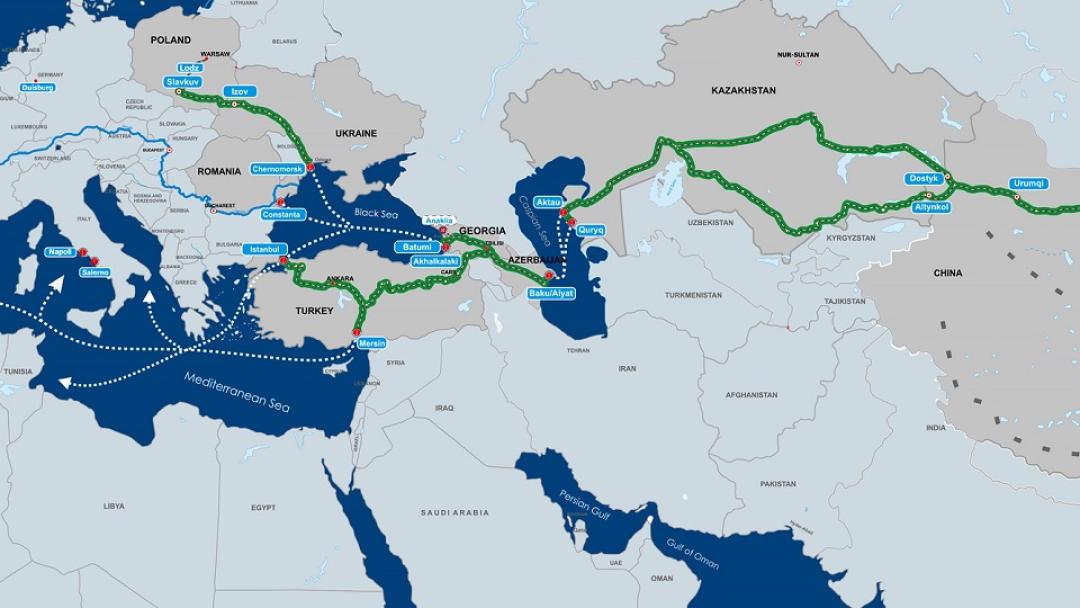
On September 9, Azerbaijan held high-level discussions with China and the US on the development of the Middle Corridor, the Zangezur Corridor, and logistics digitalization, emphasizing trade expansion, strategic partnerships, and investment opportunities.
Rashad Nabiyev, the Minister of Digital Development and Transport of Azerbaijan, announced on X that he had met with a delegation led by Ke Jixin, the Deputy Governor of China’s Zhejiang Province. "During the meeting, we discussed transportation, logistics, the development of the Middle Corridor, and future prospects for cargo transportation. We also exchanged views on the digitalization of logistics corridors," Nabiyev stated. He added that both sides agreed to establish a working group to promote cooperation in automation and digitalization between the Port of Ningbo and the Baku International Sea Trade Port.
Mikayil Jabbarov, the Economy Minister of Azerbaijan, also highlighted opportunities for foreign investment. Writing on X, he noted that during a meeting with representatives of the US Certified Business Delegation to the Middle Corridor, Azerbaijan invited American companies to take advantage of its favorable business and investment climate. He emphasized the importance of strengthening the Azerbaijan–US strategic partnership to diversify trade and energy routes and maximize economic benefits for the region.
Fariz Aliyev, the head of the Transport Policy Department of the Ministry of Digital Development and Transport of Azerbaijan, announced that work on the Azerbaijani section of the Zangezur Corridor is planned for completion in 2026. He reported that cargo transportation along the Middle Corridor had increased nearly fivefold compared to 2019, with 358 block trains sent from China to Europe in 2024. "The work on creating the corridor on the territory of Azerbaijan is expected to be completed within the next year. With the development of the Zangezur Corridor, an additional 15 million tons of cargo will be transported along the Middle Corridor," Aliyev stated. Speaking at an event marking the 5th anniversary of the European Railway Express and the arrival of the 237th Yiwu–Baku train via the Trans-Caspian International Transport Route, Aliyev added that Azerbaijan planned to send 450 block trains to China this year, with a medium-term target of 1,000 annually. He stressed that Azerbaijan’s location on the Silk Road created fertile ground for stronger trade, economic, cultural, and political ties with China, and that cooperation between the two countries had risen to the level of a strategic partnership.
Kenneth Angell, the Executive Director of the US International Development Finance Corporation (DFC), stated during a briefing in Baku that the Middle Corridor would soon open broader opportunities for East-West transportation. "The key task is to guarantee the movement of cargo from Europe to China or in the opposite direction along this route. In both directions, there is a sufficient amount of cargo for transportation. In other words, this simply opens up an additional route for the movement of goods," he said. Angell also linked economic development to peace between Azerbaijan and Armenia. He recalled that an agreement signed on August 8 marked the first step toward a peace treaty, noting that "the establishment of peace will lead to economic development, and this in turn will lead to increased prosperity". He explained that the DFC, alongside the US Ex-Im Bank and the US Trade and Development Agency, provided financial instruments to support exports, feasibility studies, and investments. "The DFC provides debt and equity support for projects that are considered a priority for the US. Among the main priority sectors in which we work are critical minerals, critical infrastructure, agriculture and healthcare. In this particular mission, the focus is mainly on ports, transportation and logistics," Angell emphasized.
Regarding the Zangezur Corridor, Angell underlined that US companies were prepared to take part in related projects. "On one side, Russia, and on the other side, Iran do not want this corridor to open. Türkiye, however, supports the opening of the corridor. Armenia would also like to see this, as they view the opportunity to collect fees for cargo passing through the route as an advantage. I believe this process will require certain security guarantees, as well as diplomacy. But this is a different issue from economic development," he stated. He added that once the corridor opened, US companies would be ready to submit proposals for tenders. Jeff Ehrlich, the Executive Director of the American Chamber of Commerce in Kazakhstan, echoed this view, stressing that US firms were global leaders in technology, capital, and skills. "There is a great demand for US technology, capital, skills, and products. I hope that there will be certain opportunities in this area as well," he emphasized.