
Pashinyan Reaffirms Armenia’s Sovereignty, Peace With Azerbaijan, Regional Economic Cooperation, and EU Integration
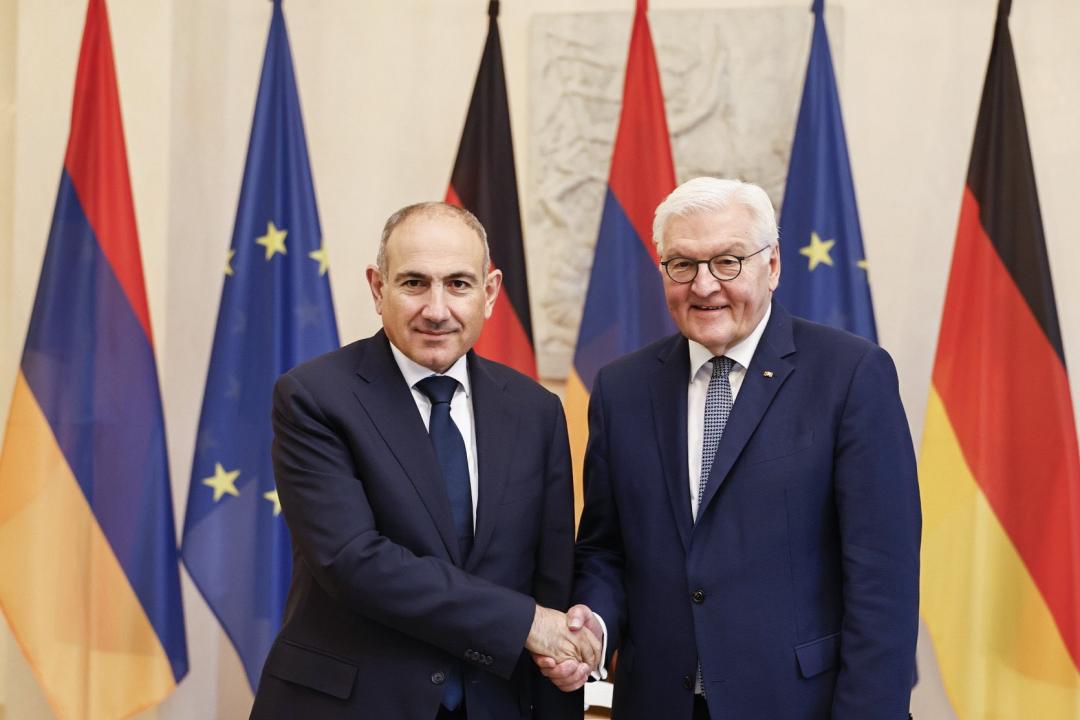
Source: official account of Armenia's PM on X
On December 10, Armenian Prime Minister Nikol Pashinyan, speaking to journalists in Hamburg, stated that Armenia has never discussed and is not discussing any constitutional changes with Azerbaijan, insisting that the Constitution of the Republic of Armenia is an internal matter. Responding to questions about Azerbaijan’s claims that Armenia must amend its Constitution, Pashinyan emphasized that Yerevan has set no conditions for signing a peace agreement.
He explained that if Baku genuinely believes the Armenian Constitution contains territorial claims, the most effective solution is the immediate signing of the peace treaty. Once signed, the agreement must, by law, be sent to the Constitutional Court to determine its compatibility with the Constitution. If the Court confirms compatibility, the document can be sent to the National Assembly for ratification, after which the treaty will hold superior legal force over domestic legislation. In such a case, Pashinyan noted, Armenia would not be able to make territorial claims against Azerbaijan even if it wanted to, because the treaty, which publicly states that both sides recognize each other’s territorial integrity based on Soviet administrative borders and renounce present and future territorial claims, would take precedence. He added that parties to the treaty cannot refer to domestic legislation as a reason for non-compliance.
Pashinyan also described the second scenario: if the Constitutional Court finds the treaty incompatible with the Constitution. In that case, he said, he would personally initiate constitutional amendments because peace is a value significant enough to justify such changes. However, he stressed that he currently has no legal basis to request constitutional amendments from the public, since the Constitutional Court already ruled in September 2024 that the Alma-Ata Declaration—explicitly referenced in the draft peace agreement—fully complies with the Constitution. According to him, changing the Constitution now without necessity would be perceived as arbitrary. He reiterated that the Constitution has never been discussed with Azerbaijan and reminded that the Civil Contract party had already included the idea of a new Constitution in its recent congress declaration, reflecting discussions that began as far back as 2018.
Addressing another topic, Pashinyan said he had read the Azerbaijani Foreign Ministry’s reaction to the strategic agenda of Armenia and the EU, noting contradictions between Baku’s claims about "Western Azerbaijan" and its criticism of Armenian references to "Karabakh Armenians". He recalled his earlier public remarks describing the issue of return as dangerous and said that both societies face sensitive questions related to narratives of return. For this reason, he made an open proposal to Azerbaijan to jointly develop a roadmap addressing these matters in parallel, arguing that a coordinated, realistic approach would contribute to long-term conflict prevention. He said he had explained to displaced people from Nagorno-Karabakh that calls for return were not realistic under current conditions. Pashinyan also referred to his previous comments in the National Assembly about the state debt, noting that two main spending areas increase the debt: defense procurement and support for displaced persons from Nagorno-Karabakh. He argued that insisting on a policy of "return" would restart the Karabakh movement, which he believes has already ended, and that attempts to revive it are futile. At the same time, he noted that Armenia hears Azerbaijani officials promoting the concept of "Western Azerbaijan," creating a dynamic where each side responds to the other’s rhetoric. To break this cycle, he reiterated his proposal for a bilateral roadmap that would permanently remove these issues as sources of conflict. Pashinyan emphasized that there can be no "Western Azerbaijan" in Armenia. If both states recognize each other’s territorial integrity, then both must commit to implementing this recognition fully.
He then addressed Armenia’s strategic orientation, stating that withdrawal from the Eurasian Economic Union (EAEU) is not a current objective, whereas membership in the European Union is a long-term goal. He acknowledged that the two are incompatible and that a choice will eventually be required, but stressed that no such decision needs to be made now. The recently adopted law initiating the EU accession process serves primarily as an incentive to deepen democratic reforms and to bring Armenian governance, economy, and standards in line with those of the European Union. Only once Armenia objectively meets EU standards would it formally apply for membership. At that stage, he said, the EU may or may not accept Armenia, but either outcome would be beneficial, because by that time Armenia would already function at the level of an EU-standard state.
Discussing regional economic projects, Pashinyan said that the TRIPP project and broader infrastructure initiatives were part of his talks in Hamburg. The Port of Hamburg, he reported, has expressed particular interest in the project to build a dry port in Gyumri, and this interest has grown given current regional developments. He added that his visit generated several significant topics for future cooperation. He highlighted another development announced in Berlin: beginning next year, the German Embassy in Armenia will eliminate the long visa queues. He said he hopes this approach will extend to other embassies as well.
Pashinyan described Armenia’s foreign policy as balanced, citing his recent visits to multiple capitals. He said that Armenia’s 2021 government program prioritizes regionalization and that this year he has held meetings with all neighboring leaders. He noted that two Armenian delegations had already visited Azerbaijan this year and that he expects Azerbaijani delegations to visit Armenia soon. He mentioned that a train had entered Armenia from Azerbaijan and that the two sides are discussing the import of petroleum products. This, he argued, illustrates the success of a balanced foreign policy. He further underlined that the atmosphere created by international partners is essential for progress in Armenian-Turkish normalization, including the opening of the border. Within the framework of the Crossroads of Peace and TRIPP projects, opening the border would create a rail and road connection from Central Asia to the European Union and could enable future infrastructure such as new pipelines and power lines, including potential "green hydrogen" corridors. Pashinyan said these ideas once seemed speculative but now appear realistic, and that a Central Asia–Europe green hydrogen pipeline would inevitably materialize. Opening the Armenian-Turkish border, he said, would give this future pipeline an additional viable route, beneficial for both the region and the EU.
Speaking in Hamburg to representatives of the business community, Pashinyan said that while political leadership was demonstrated on August 8, the economic sector is now leading developments. He argued that shared regional economic interests are the most reliable guarantee of stability and security, since businesses that profit together have no incentive to support conflict. He encouraged Armenian entrepreneurs to engage more deeply in regional economic cooperation.
Pashinyan discussed Armenia’s progress in renewable energy, emphasizing that solar power generation has expanded substantially and that current solar capacity exceeds that of the Armenian Nuclear Power Plant by a factor of three. He highlighted the importance of energy storage systems for achieving energy independence and future electricity exports. He also noted a growing opportunity for cooperation with the EU in technological fields and said that entrepreneurs exporting Armenian products to Europe are receiving government support. Germany, he added, is showing strong interest in hydrogen technologies, an area Armenia has begun exploring.
He also commented on public narratives about Nagorno-Karabakh, arguing that headlines claiming the Karabakh issue is unresolved echo inside both societies and perpetuate mistrust. He insisted that peace has already been achieved and that all major issues have been resolved. What remains, he said, is simply to adhere to these decisions and avoid provocations.
Finally, Pashinyan addressed Armenia’s dramatic increase in travel to the EU. He stated that compared to 2018, trips to EU countries have grown by 400–500%, and when accounting for visa queues, the real increase is closer to 600–700%. He dismissed claims that rising travel contradicts data on living standards, noting that affordable airline tickets (sometimes 35 to 50 euros) have enabled ordinary citizens to travel frequently. The statistics, he added, are provided by the European Union itself.