
Rubinyan Defends Pashinyan Against Opposition; Explains Nagorno-Karabakh Proposals, Territorial Claims, And Demarcation Processes
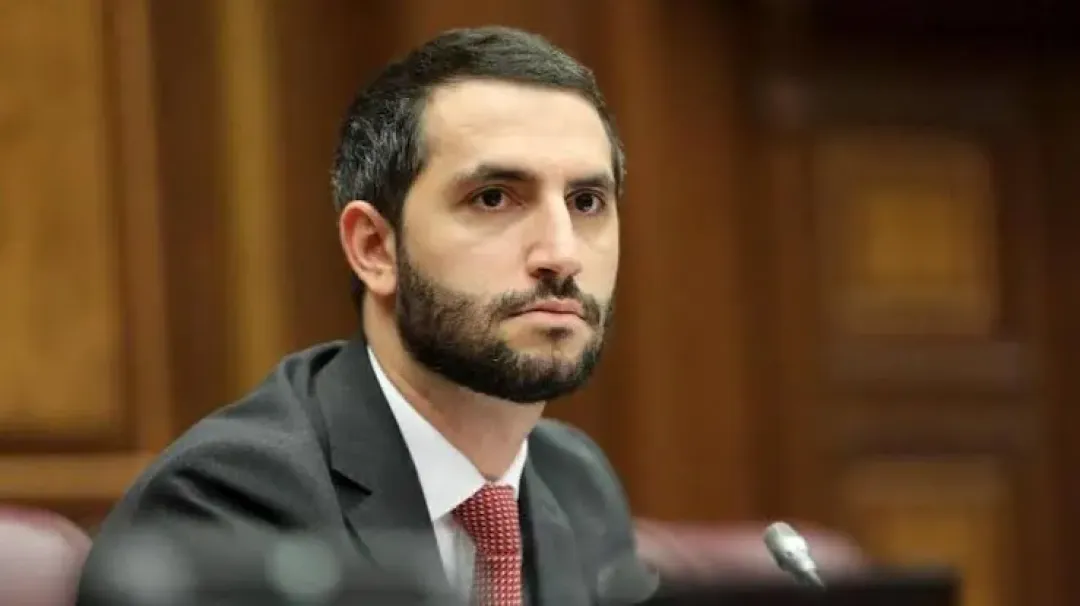
On November 11, Ruben Rubinyan, the Deputy Speaker of the National Assembly of Armenia, refuted Azerbaijani claims about Armenia provoking war, rejecting accusations of halting negotiations, while addressing opposition criticisms, territorial issues, and the 2019 proposals concerning Nagorno-Karabakh.
Rubinyan stated this to journalists in parliament while responding to Azerbaijani Foreign Minister Jeyhun Bayramov's remarks that Armenian Prime Minister Nikol Pashinyan had abruptly abandoned negotiations, causing a stalemate and war.
"I must say that the Azerbaijani Foreign Minister, Robert Kocharyan, Serzh Sargsyan, and Levon Ter-Petrosyan are incorrect in their statements: Armenia did not provoke the war, Armenia did not start the war, Armenia did not terminate the negotiation process. I disagree with Jeyhun Bayramov, Robert Kocharyan, Serzh Sargsyan, and Levon Ter-Petrosyan. I disagree with the facts they present, as they do not correspond to reality," Rubinyan stated.
Addressing claims about Pashinyan's statement "Karabakh is Armenia, period," Rubinyan said, "But Robert Kocharyan said: Karabakh has been part of Armenia since 1988 and continues to this day. According to the logic of Robert Kocharyan and his colleagues, did he provoke the war?"
Regarding proposals on the negotiating table in 2019, Rubinyan emphasized, "Was there a proposal in 2019 that Azerbaijan accepted but Armenia didn't? There was no proposal in 2019 that Azerbaijan accepted but Armenia didn't. Generally speaking, since 2008, when the Madrid Principles were adopted, all proposals have been essentially the same… This means self-determination for Nagorno-Karabakh within Azerbaijan". He added that the 2019 proposal reflected the end of Serzh Sargsyan's presidency and was not rejected by Armenia. "Armenia did not reject a single proposal," Rubinyan noted.
He further criticized former presidents for claiming brilliant proposals existed during their tenure. "So if there were so many brilliant proposals, then why weren't they implemented? Furthermore, we have actually seen the implementation of the proposals implied by the Madrid Principles in practice. At least, all the proposals put forward in the 2010s envisioned the withdrawal of Armenian forces from seven districts, with various variations. At the very least, Russian peacekeepers were stationed in Nagorno-Karabakh and around the Lachin corridor, and there was no status issue. Everything I said was reflected in the November 9 statement. And we've already seen what happens when Armenian forces withdraw from parts of seven districts, leaving the Lachin corridor and Russian peacekeepers in Nagorno-Karabakh," he stated.
Rubinyan also addressed opposition claims about ethnic cleansing and imports from Azerbaijan, saying, "The son of Serzh Sargsyan's former chief of staff said in an interview that in 2023, the Armenian Prime Minister brought Armenians from Nagorno-Karabakh to Armenia. Nikol Pashinyan, as if nothing had happened, subjected Nagorno-Karabakh to ethnic cleansing. That's what they are like – these people. I understand that this is opposition activity, but we need to distinguish between the struggle against the government and the struggle against the state".
On wheat imports, he noted, "I think this is already telling. I'm not a wheat expert, so maybe you should contact the Ministry of Economy? But I don't think any individual entrepreneur would want to import wheat that won't serve its purpose. And what about wheat from Russia? Are they satisfied with it?"
Regarding territorial issues, Rubinyan stated, "Artsvashen is our territory. I am constitutionally obligated to speak about the need for its return. And this is not just about the territories of Artsvashen and the Jermuk section; there are also sections in Syunik and Tavush". On road infrastructure concerns if enclaves are transferred to Azerbaijan, he explained, "These issues are subject to discussion in demarcation commissions. Theoretically, if a decision is made to exchange land, it can only be done through a referendum".
On accusations that Karabakh was Armenian under previous authorities but not now, Rubinyan responded, "When Karabakh was Armenian, Armenians lived there, and we offered a way. When we declared that the bar should be lowered, Robert Kocharyan, Serzh Sargsyan, the ARF Dashnaktsutyun, and the forces associated with them in Nagorno-Karabakh began accusing us of treason. And what did they do? They forced Arayik Harutyunyan to resign, elected a president in Nagorno-Karabakh, and then held rallies in Yerevan".
He added, "Our opposition colleagues' discussions are somewhat absurd, because when Prime Minister Pashinyan doesn't talk about the return of our occupied territories for three days, they ask: 'Why doesn't he talk about it?' And when he says that we must return our occupied territories, including Artsvashen, they say: 'What does that mean? He's going to make concessions'".
Regarding the enclave issue, Rubinyan explained, "It must be resolved within the framework of the demarcation commissions. They have adopted a working procedure. This implies that they must present the legal basis to each other, discuss it, present their existing cartographic and legal basis for various areas, and so on. Demarcation must be carried out, protocols must be signed. And only after the demarcation process is completed should a delimitation agreement be signed. This will definitely not happen before the elections, as it is a lengthy process. The demarcation process allows for the exchange of territories, but if, for example, no territorial exchange occurs, then there is no need for a referendum. There is no news on this matter at the moment".
News,
Politics,
Armenia |
Robert Kocharyan, Nikol Pashinyan, Serzh Sargsyan, Levon Ter-Petrosyan, Ruben Rubinyan