
TAP Maintains Stable Gas Deliveries to Europe Despite Minor Weekly Fluctuations
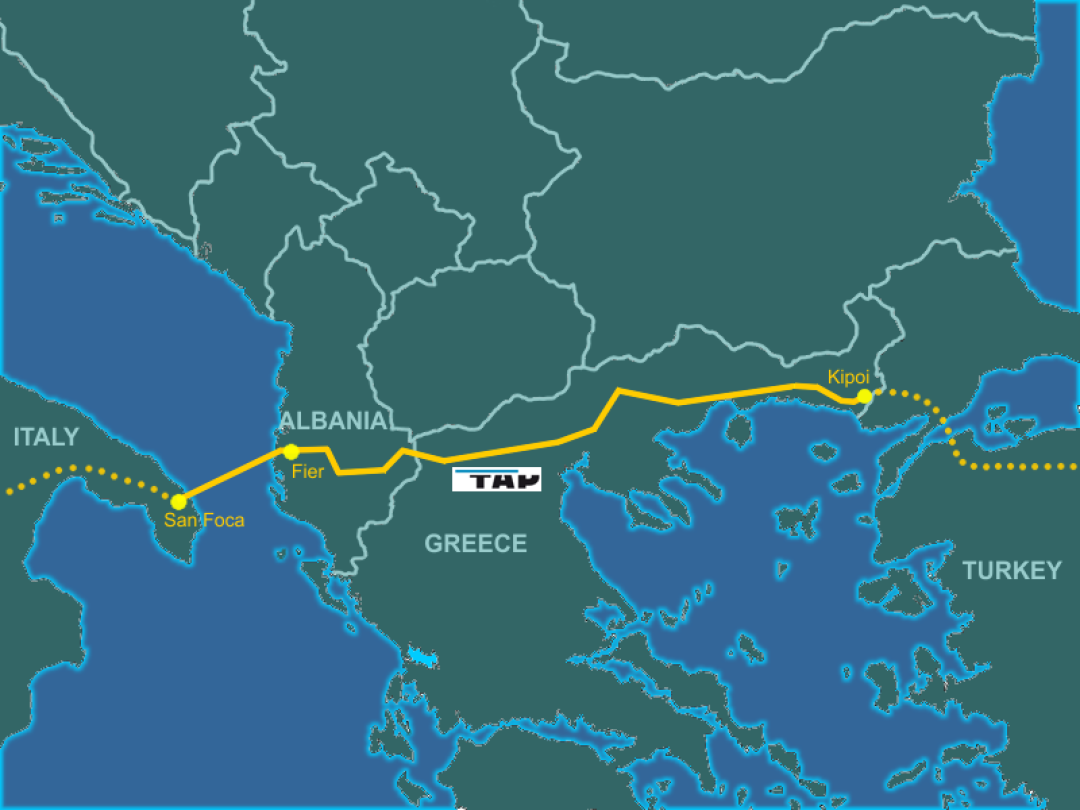
On September 1, the Trans-Adriatic Pipeline (TAP), which transports Azerbaijani natural gas to Europe, received an order of 366,957,291 kWh at Greece’s Kipoi exit point, representing a 6% increase compared to the previous Monday. From September 2 to 8, the order volume at Kipoi totaled 331,019,866 kWh, showing a 4.37% decrease compared to August 26, a 4.27% drop compared to August 27–29, and a 4.28% decline compared to August 30–31. At Greece’s Komotini exit point, daily orders during the same period remained stable at 28,674,418 kWh, identical to the previous week. At the Nea Mesimvria exit point, TAP recorded 30,346,301 kWh, also unchanged from the prior week.
In Italy, TAP registered an order of 301,940,315 kWh at the Melendugno exit point on September 1, a 5.9% increase compared to August 25. From September 2 to 8, orders at Melendugno reached 271,999,147 kWh, reflecting a 4.6% decrease compared to August 26, a 4.49% drop compared to August 27–28, a 3.3% decline compared to August 29, and a 3.13% fall compared to August 30–31.
According to a statement from the TAP AG consortium, the operator of the pipeline, TAP has transported its 50 billionth cubic meter (bcm) of natural gas to Europe since the start of commercial operations in late December 2020. Of this, more than 41.7 bcm were delivered to Italy, over 4.8 bcm to Greece, and over 3.2 bcm to Bulgaria.
Luca Schieppati, the Managing Director of TAP, emphasized, "Reaching 50 bcm is more than a milestone – it's a clear demonstration of TAP's strategic role in strengthening Europe's energy security and supporting climate goals. By safely and reliably delivering gas from a new source and a new route, TAP has helped diversify South-Eastern Europe's energy mix and reduce reliance on heavier fossil fuels, while also progressing along a decarbonization pathway for our operations." He noted that the first phase of TAP’s capacity expansion, set to add 1.2 bcm annually from 2026, was already underway and could pave the way for further expansions depending on market demand and Europe’s evolving energy landscape.