
Combining European and Eurasian Integrations in Armenian Public Opinion
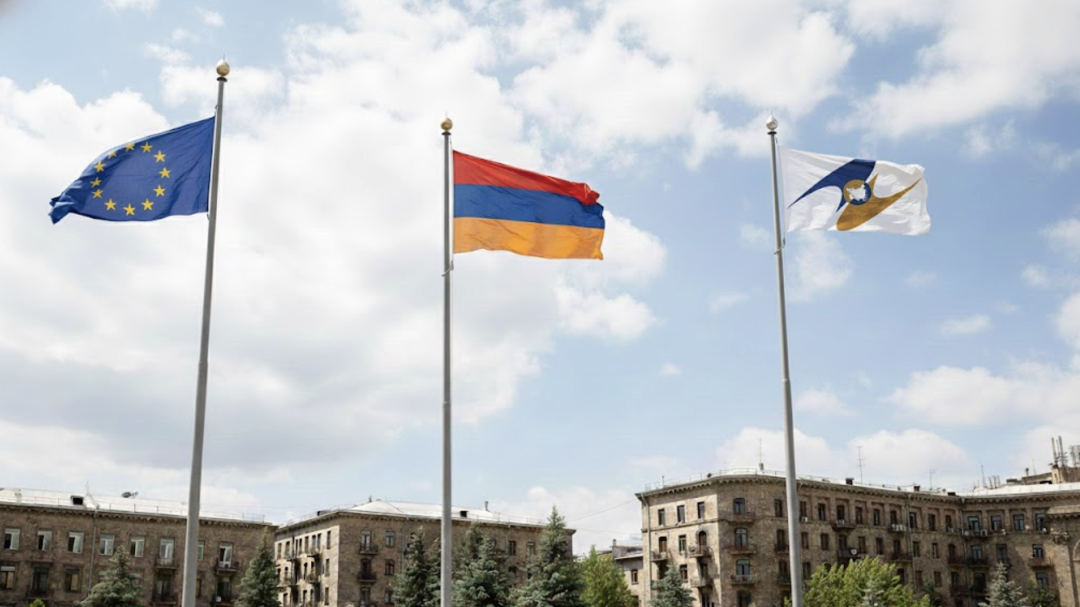
Among post-Soviet countries, Armenia has a unique position in terms of international integration. Combining the Eurasian and European integration paths has always been a primary goal of the foreign policy of the Republic of Armenia. The topic of joining the European Union has been actively discussed, specifically, during the current year. Some political circles are even organized a referendum petition on launching a process of Armenia’s accession to the European Union. The Armenian National Assembly adopted the law on launching the process of EU membership in the first reading on February 12, 2025, and in the second and final reading on March 26, 2025. The visa liberalization process has kicked off.
On the other hand, the question arises: isn't pursuing a European integration course premature if Armenia remains, at least officially, an ally of Russia?
Armenia has been a member of the Collective Security Treaty Organization (CSTO) since 1994 and the Eurasian Economic Union (EAEU) since 2015. It is evident that, at least for the moment, Yerevan remains within the scope of Moscow's interests—perhaps less so politically, but definitely in the economic sphere.
The combination of European and Eurasian integration paths has always been a constant topic of disagreement and debate, not only between the Armenian government and opposition but also across public opinion.
Can the alignment of these two vectors be genuinely viewed as a double development opportunity for Armenia, or do they instead represent two insurmountable obstacles? This article attempts to answer that question.
EU vs EAEU? Armenian public opinion according to polls
Political analyst, Head of the Organization Integration and Development and Coordinator of Eurasian Expert Club, Aram Safaryan, in a conversation with us for this article, informed that back in October-November 2013, before the launch of Armenia's Eurasian integration vector, their organization conducted a large-scale sociological survey with partners. That poll showcased that 70% of the Armenian population is in favor of Eurasian integration and wants to see Russia as the locomotive of the integration process. To the question: "What if the two integration vectors do not coincide, and we have to make a choice, which one would you choose?", the respondents again answered Russia by 70%. According to Aram Safaryan, those moods existed at that time because on the eve of the formation of the EAEU, there was hope that Russia should help Armenia restore and develop its industry and should make investments that would boost the Armenian economy. That survey also showed that in the field of science and education, the people of Armenia prefer the European Union and hope to obtain modern knowledge, technologies, and development opportunities through it.
12 years have passed, the mood has certainly changed, and according to another survey conducted by the same organization, now 40% of the Armenian population consider cooperation with the EAEU to be a priority, and another 35% consider cooperation with the EU important, the rest are uncertain or are nationalists who believe that we should be included nowhere.
According to the results of the 2024 annual survey in Armenia conducted by the "EU Neighbours East" program, 62 percent of the country's citizens trust the European Union. This index is the highest among all other international institutions and is 19 percentage points higher than the index two years ago, while almost four out of five respondents (78%) evaluate the EU-Armenia relations positively. Recent polls also showcase that the majority of the population, especially in the capital, is in favor of the liberalization of the visa regime between Armenia and the EU and considers this process a positive and necessary development for Armenia.
Withdrawal from the EAEU could be disastrous for Armenia's industry: Expert opinions
The incumbent PM of Armenia in his speech in the European Parliament, in 2023, announced that Armenia is ready to be closer to the European Union, as much as the European Union considers it possible , at the same time, he believes that the Armenia's European integration perspective is a matter of the next 20 or more years. Meanwhile, according to Aram Safaryan, those 20 years were necessary to live, and for this intention, the following is formulated by the Armenia’s Minister of Foreign Affairs: " We talk about European integration and are part of Eurasian integration". This correct formula, as per Safaryan, seems to answer that key question of compatibility, however, Armenia is being told by both the EU and the EAEU that combining these two vectors will not be possible, therefore, at X moment, when Armenia takes certain steps in one direction or another, the other door will close. Aram Safaryan considers this a delicate and sensitive issue, as it raises new questions.
Pro-Western figures in Armenia argue that since Russia has proven that it is neither Armenia's patron, nor guarantor, we should alienate from it and cease buying Russian gas, exit trade regimes with Russia. The question arises: won't this undermine the Armenian economy? Aram Safaryan is convinced that it will, and leaving the EAEU is something like a disaster for Armenia's industrial complex today, especially, given the privileged positions that, for example, tourism and the service sector in Armenia have, which stem from its membership in the EAEU.
Aram Safaryan also mentions that Armenian socio-political course tried to combine two vectors of integration back in 2017. A concrete manifestation of this was, while being a member of the EAEU since 2015, Armenia continued negotiations and signed an Association Agreement with the EU in 2017, to the satisfaction of both sides, the EU and Armenia.
The political analyst also makes a mid-term prognosis that for the next 5 years, it will be beneficial for Armenia to retain the membership with the EAEU and, together with Russia, develop relations with the Shanghai Cooperation Organization and BRICS+.
"Today, when Armenia has achieved striking economic success over the past 7 years, increasing its per capita GDP from $4,400 to $8,900, (as per International Monetary Fund ), that is, it has developed by 60%, it shows that we have been on the right track in choosing our external policy vectors. On the other hand, Armenian society is waiting for the EU-Armenia rapprochement and development of relations in the political arena, not only because it considers itself a part of Europe in terms of civilization, but also because the EU has promised Armenia to open its borders for visa-free travel if Armenia follows the path of certain reforms, particularly in the area of human rights.
Eurasian vs European Union - compatible or contradictory models?
In an interview with Caucasus Watch, Professor of Economics, Head of the “Alternative” Research Center Tatoul Manasseryan expressed an opinion that Armenia's membership in the EAEU does not limit Armenia-EU relations, both political and cultural, as well as economic, including trade, investments, capital inflows, etc., as there are no objective distinctions between these two models. "Those who claim the opposite are merely speculating in order to mislead the society and the state to become alienated from its traditional partners. I will present it with facts to make it clearer. Inherently, Armenia, Kyrgyzstan, and Kazakhstan, among the EAEU member states, are considered members of the World Trade Organization, and this means that they have admitted and are applying all the standards and international norms of this organization, otherwise, they could not become a member of the latter. On the other hand, all 27 countries of the European Union are members of the World Trade Organization. It needs simple logic to comprehend that these countries are employing common standards, which are internationally recognized global standards and not specific for the EAEU and the EU. Secondly, the supreme body of the Eurasian Economic Union, the Commission, has repeatedly stated through its various documents and high-ranking officials’ speeches that the EAEU is trying to implement the European Union model, that is, free trade, fair competition, etc. In other words, there can be absolutely no objective basis for the distinctions here”.
According to Professor Manasseryan, the best solution that all countries in the world are pursuing is, literally, the principle of complementarity, and that is precisely what makes them to succeed. In this context, Manasseryan brings the example of Turkey, which has relations with everyone, and no one tells Turkey to make a choice “either...or”, and no one can even dare to, as Turkey has its own national interests.
"Unfortunately, the Republic of Armenia, since its independence, has not yet clarified its national interests, most importantly, its vision of development. If we have priorities and a national agenda that are based on national interests, it will be much clearer for us in terms of choosing integration models”, Manasseryan believes.
Our next interlocutor, the pro-European politician, Chairman of the European Party of Armenia, Dr Tigran Khzmalyan, however, has the opposite opinion and claims that in economic, political, and civilizational terms, the Eurasian and European approaches are mutually contradictory, especially at this stage.
"Until 2020, Armenia pursued a policy of convergence. After all, the 3rd President of Armenia, Serzh Sargsyan, was going to sign the Euro Association Agreement in 2013, and then the disgrace of September 3 happened, when he was summoned to Moscow and simply very rudely offered an ultimatum: immediately withdraw from the Euro Association Agreement, which was to be signed in Vilnius on November 26 of that year, and join the union called the Customs Union, later renamed the EAEU. If we believe what happened before our eyes, how can we debate for years whether these paths are compatible or not? Putin said that no, and this is the ultimatum by the colonizer of our colonized country. There's nothing even to discuss here. If anyone doesn't find this convincing, let's recall that the Ukrainians rejected the ultimatum in those same days and the Euromaidan has kicked off, which continued with the annexation of Crimea and Dombas and continues to this day in the form of the Russian-Ukrainian war. Armenia is currently not in a position to afford lavishness to promote and maintain traditional political balance. In other words, discussing in a serious, academic tone whether these two models are comparable or not sounds, first of all, hilarious. And particularly, after the 2020 war, when our so-called strategic ally, who had been showing for 100 years and showed once again that he was actually our strategic enemy, there is no point in talking about it, thus we are simply insulting people's intelligence”, Khzmalyan claims.
Armenia's European integration process: imitation or a well-thought-out course?
Some opposition forces in Armenia consider the European integration process currently underway within the country as merely "imitational". We tried to find out from our interlocutors whether these claims have any basis in truth.
Aram Safaryan, for example, categorically disagrees with that formulation; moreover, he is reassured that the current European integration process is a well-thought-out political course by the authorities, developed and agreed upon down to the smallest detail in oral and written conversations with European partners: "There is a process of reforms that Armenia will carry out as long as the membership issue is not resolved. No one is rushing Armenia, but they (EU) will demand that if you want to have good relations with us, you must bring your infrastructure into line with European standards. And this is the direction that Armenia's political course will take, the course that has been strategically outlined since 1993-94”. Aram Safaryan also reminds that during the tenure of Armenia's first president, the question of whether Armenia is a European state was raised, and that struggle continued for 10 years until Armenia was admitted to the Council of Europe in 2004: "I can foresee that the Armenian authorities will adopt the Eurasian vector as an economic integration, and on the other hand, precise steps will be taken to Europeanize Armenia's political, social, and legal structures in order to avoid criticism that the current authorities are creating an imitation of European integration," Safaryan concludes.
In response to the question whether the current process of European integration is realistic, Professor of Economics Tatul Manasseryan noted that this process has always proceeded in parallel during the years of independence and nothing new is being said here: “We just need to consider that what happened at the beginning of this year, that is, the adoption of a law on EU membership, is probably from the tragicomedy genre or is simply intended to mislead people. First of all, this is the first case; none of the 27 EU member states has adopted such a law, and only then joined the latter. I am sure that in the next 10 years that law will have zero force, it is not by law to access the European Union, this is merely untenable”
Tatul Manasseryan believes that the continuity of the European integration policy indicates that Armenia is very serious about developing economic ties with both the EU and any country in the world, and no one should preclude this path or dictate their will from the side.
"Nevertheless, I think that, at least, no one in the European Union is waiting for us with open arms, because the EU has its own problems today, and secondly, even if the Republic of Armenia meets all European criteria, it is still too premature to talk about membership”, Tatul Manasseryan is convinced.
Dr. Tigran Khzmalyan, however, holds the opposite view and claims that currently there is no ongoing process of European integration at all, and what is happening now is merely an imitation:
"I was the initiator of the European Union membership law, which was amended in the further and the deadlines disappeared, but at that moment we thought that at least let the law be in this state and we would be able to implement it later. However, after the law was adopted, a month later Pashinyan sent an application to join the Shanghai Cooperation Organization, then he was flirting with BRICS+, that is, he continued to remain a member of the Eurasian Union and only increased the Russian presence in our country. He brought trade turnover with Russia to record levels and ensured and still partially conducts smuggling trade through Armenia, in favor of Russia, which helps them acquire finances and special equipment to continue the war in Ukraine. In other words, Armenia remains a Russian colony and continues the political course of the former authorities, therefore, I do not believe in Pashinyan's European integration, I call it Euro-imitation”, Tigran Khzmalyan claims and draws a comparison with neighboring Georgia: "That's exactly what Georgia did at the time, and which is already obvious to Europe. And we, pro-European figures, are trying to explain to Europeans through our means that absolutely the same process is taking place in the case of Armenia in nowadays”, Khzmalyan concludes.
Conclusion
The foreign policy priorities of the current government of Armenia remained largely consistent with the foreign policy pursued by previous governments, including cooperation with Russia and the EU. It is very important that Armenia pursues a foreign policy in which cooperation with both sides is not viewed as mutually exclusive, but rather as mutually complementary and balancing. In addition, it should be taken into account that Armenia's foreign policy is greatly determined by the regional geopolitical environment and the constant threats it faces to security. Therefore, having to make a difficult geopolitical choice, Armenia, as a post-Soviet country, can be considered a special case for studying the interconnected processes of post-Soviet transformation, internationalization, Europeanization, and integration, which have different levels and vectors. This testifies to Armenia's capabilities and possibilities to work with two large integration unions: the European Union and the Eurasian Economic Union, the implementation of which requires the adoption of a policy that will not lead to a choice between the two, on the contrary, Armenia can achieve a balance between the two poles, turning European and Eurasian integrations into two opportunities for development, rather than two obstacles.
About the Author: Anna Vardanyan is an Armenian political journalist and researcher who has specialized in defense policy, international relations and security in Eastern Europe and the Caucasus for over 18 years. She has worked for several Armenian media outlets and held advisory roles in the National Assembly of Armenia. She is the awardee of the “Tytus Filipowicz” Academic Award provided by the Centre for East European Studies of the University of Warsaw.
Insights,
Politics,
Armenia |
EU, Russia, Nikol Pashinyan, EAEU, Tatul Manaseryan, BRICS, Aram Safaryan, Tatoul Manasseryan, Tigran Khzmalyan