
India and China in the South Caucasus: Quiet Strategies Behind Global Corridors
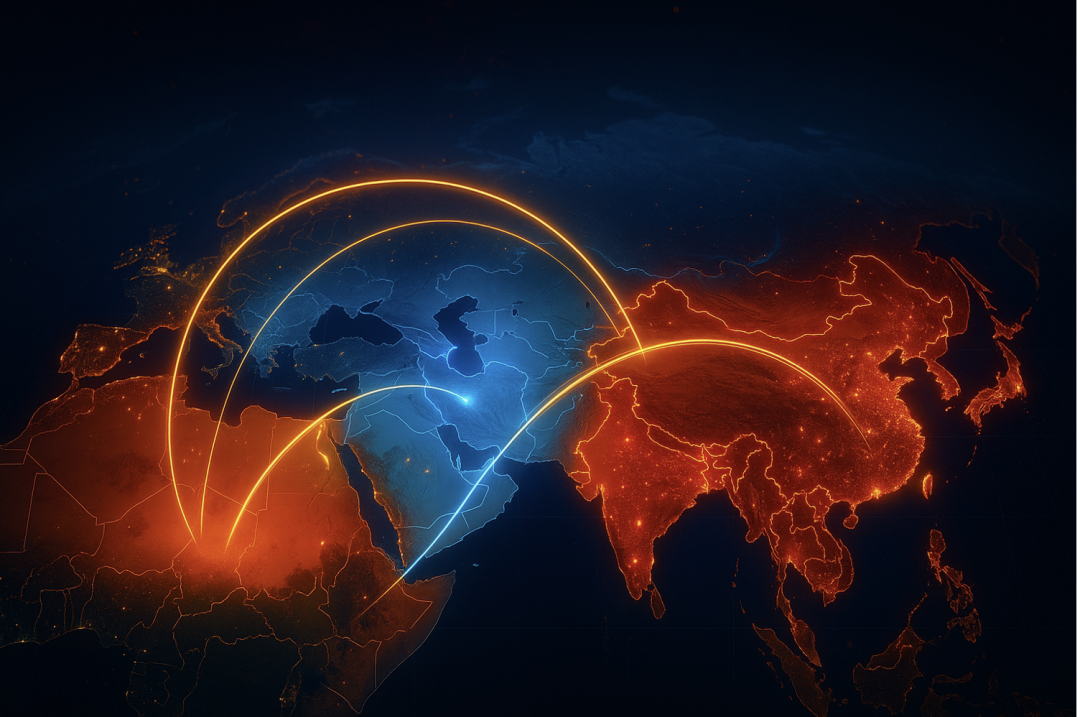
As connectivity projects redraw Eurasia’s map, India and China are paying attention to the South Caucasus—but from a careful distance. Professor Osamu Yoshida of Hiroshima University reflects on how Asia’s major powers see the region, and what lessons the Caucasus might draw from East Asia’s own experience with cooperation and competition.
The South Caucasus—Armenia, Azerbaijan, and Georgia—has re-emerged as a transit space between Asia and Europe. Everyone from the European Union to regional actors is seeking routes that bypass geopolitical bottlenecks. In this setting, it is natural to ask: where does Asia stand?
According to Professor Osamu Yoshida of Hiroshima University, who researches international relations and South Asia, both India and China are watching the region closely but not rushing in. Their caution, he suggests, says as much about their global strategies as it does about the Caucasus itself. (Hiroshima University profile)
India: Watching, but Not Racing
India’s presence across Eurasia runs mostly through the International North–South Transport Corridor (INSTC), which connects Mumbai to Russia and Northern Europe through Iran and the Caspian. (ResearchGate study on INSTC) Yet despite the corridor’s proximity, India’s practical role in the South Caucasus remains modest.
“India doesn’t yet have the capacity to project strongly into the Caucasus,” Yoshida says. “The Shanghai Cooperation Organisation gives it a way into Central Asia, but not beyond.”
New Delhi’s strategic attention is divided among its neighbourhood, the Indo-Pacific, and its long-standing cooperation with Russia. Given that background, India’s diplomacy toward the Caucasus tends to favour balance and continuity rather than experimentation.
Even ambitious ideas such as the so-called Trump Route for International Peace and Prosperity (TRIPP) have not altered that approach. “India is cautious,” he explains. “Even if TRIPP begins operating, it’s unlikely that India will move quickly—its policy remains one of careful observation.”
In essence, India is present—but on its own terms.
China: Infrastructure over Politics
China, by contrast, has been visibly active in Eurasian infrastructure. Through the Belt and Road Initiative, it has funded and built transport links from Central Asia toward the South Caucasus and the Black Sea. (OECD Report, 2023)
Still, Yoshida stresses that Beijing’s interest is not primarily political.
“China’s priority,” he explains, “is connectivity—especially in the western part of the Eurasian continent. It’s about infrastructure and trade efficiency, not influence.”
Recent analyses confirm this pragmatic orientation. (RSDI Analysis) Chinese companies have invested in logistics and transport hubs in Georgia and Kazakhstan, while trade volumes with the region continue to grow. Yet China’s engagement remains limited to the economic domain.
“China wants peace,” he adds. “The TRIPP concept looks risky from Beijing’s point of view. Northern countries might find a compromise, but China won’t follow a route that threatens stability.”
It’s a logic consistent with Beijing’s broader style: engage economically, stay politically quiet.
A Region under Observation
Both India and China therefore approach the South Caucasus with caution, each for its own reasons.
“They will observe, but not lead,” Yoshida says. “The region itself must find balance before Asia sees it as a secure partner.”

Figure 1. Comparative economic and strategic footprints of India and China in the South Caucasus (1–10 scale).
This restraint also reflects a wider pattern: the South Caucasus remains more of a crossroads than a destination in Asian strategy. Until local cooperation deepens, outside powers are unlikely to see it as a stable long-term investment.
Lessons from East Asia
When asked what the Caucasus might learn from East Asia, Yoshida points to the uneasy coexistence of competition and interdependence there.
“East Asia never developed very good cooperation among its neighbours,” he admits. Japan and China once shared intensive technological exchange that benefited both economies—but that collaboration has since weakened as national priorities diverged.
“Nowadays,” Yoshida reflects, “China prefers to go its own way. It doesn’t want the kind of cooperation it once had.”
For the South Caucasus, the message is clear: economic growth can coexist with rivalry, but without institutional trust it remains fragile.
“These lessons should be learned,” he says. “Don’t compete when you could cooperate.”
Looking Ahead
Neither India nor China is in a rush to expand their presence in the South Caucasus, yet both remain attentive. Their restraint is revealing—it shows that external engagement follows internal coherence.
The South Caucasus, Yoshida suggests, still has time to decide what kind of bridge it wants to be: one built on parallel ambitions or shared interests. Its future relevance may depend not on who arrives first, but on how well its own actors learn to cooperate.
Contributed by Siranush Grigoryan, a Lecturer at Armenian National Polytechnic University, based on insights shared by Professor Osamu Yoshida of Hiroshima University during discussions on regional cooperation and peacebuilding (November 2025).
Insights,
Politics,
Armenia, Azerbaijan, Georgia |
China, South Caucasus, Belt and Road Initiative, India, North-South Corridor, Siranush Grigoryan, Osamu Yoshida